Thursday, February 17, 2011

Is Whaling Taking a Dive?

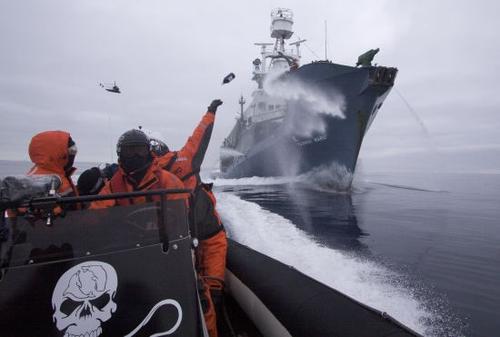
Usually lasting into the middle of March, it seems that Whaling Season in Japan is cutting their controversial sport short this year. To anyone who watches Animal Planet, one of many Discovery's channels , the show Whale Wars may have interested you at one point. In essence, the show is  described as 'The Sea Shepherd Conservation Society's ongoing struggle to end Japanese whaling', according to the show's website.  Though the television show won't premiere until Summer 2011, the Shepherds' efforts have not been interrupted. 


During this whaling season,  Japanese scientific boats depart to hunt whales for 'scientific studies', and then sold to the public as food products, a delicacy in the country. This year, however, their attempt at capturing the large, aquatic mammals has been significantly disrupted. Using only the Sea Shepherd, the main boat in the Sea Shepherd Conservation Society's (which will be referred to as the SSCS in the rest of this blog), the Japanese fleet's mother ship has been successfully chased out of Atlantic waters. Just last week, the fishery's minister has stated his fleet will temporarily return home to Japan. To the SSCS, this action is an incredible achievement, as many of the whaling boats don't usually go quietly. 


Armed with water cannons and harpoons, the Japanese ships are indeed quite dangerous when tampered with. This season, however, they have decided the fight is not worth the effort. Though the SSCS has essentially one this season's war on whaling, Paul Watson, the founder of the Sea Shepherd group stated, "We will however stay with the Japanese ships until they return north and make sure that they're out of the Southern Ocean whale sanctuary." The Japanese halted their attempts on February 10th, but they have an opinion of their own on the matter.

Japan's Farm and Fisheries Minister Michihiko Kano stated publicly, "Even now the mother ship is being chased, and it is difficult to ensure the safety of the crew members." Japan's fleet consists of approximately 180 ships designed for whale hunting, which intend to kill nearly 1000 whales in this one season. Though every ship is technically for scientific study of the whales, most of the corpses will eventually end up in the food industry as various preparations. Even with such an immense fleet, the SSCS has managed to stop this practice by preventing ships from drawing the whales onto the ships. Many Japanese citizens claim not to consume whale on a daily basis, yet still feel the interference from activists is unjustified and disrupting a cultural tradition that has been carried out for centuries. 


As this season comes to an end, the SSCS, as well as many anti-whaling efforts carried out by Australia and New Zealand, the Japanese have successfully been given the message, though this success will be short lived, as next year will be just as chaotic for all activists, and possibly with more challenges. Fortunately for hundreds of whales, they can live out a fulfilling life, without the possibility of being slaughtered. 


Personally, I applaud these activists' efforts, and am very glad that our planet's ocean will have a little less blood in the water this year. If any readers would like to continue and follow these efforts, the Sea Shepherd Conservation Society has its own website, where information will be constantly updated, as well as give an opportunity to donate to their efforts. I will be keeping my fingers crossed that these activists, in unison, will be able to dismantle the destruction of whaling, and cause it to inevitably take a final dive.
 

Wednesday, January 20, 2010

Poverty with Broken Kneecaps


As Haiti enters yet another week of dealing with the chaos wrought upon its already impoverished streets by the magnitude-7.0 earthquake that struck Port-au-Prince early January 12, the damage is now showing its grim face. Efforts to bring the country out of poverty may have been set back "by many, many years," said Stephen Randall, a senior fellow at the Canadian International Council. Though seriously set back, the major efforts of multiple aid organizations will eventually be able to place Haiti back on track, though life will forever be changed for its people.

Prime Minister Jean-Max Bellerive set the confirmed death toll to 72,000 yesterday, though estimates of the damage range up to twice that number. As well as human life, the socio-economic infrastructure has suffered a fatal blow as well; with major looting and violence occurring on a widespread basis, the fractured police and military forces are unable to put a cap on the problems in the streets. Businesses and government are unable to recover from the disaster due to the widespread mayhem, and a sort of global anarchy has spread amongst the Haitian people. Unfortunately, the violence has lead to the death of several aid workers in the past week, and many injuries amongst the population.

With that said, Haiti still needs all the help it can receive. Both the Red Cross and UNICEF are still accepting donations via text, phone and through their websites, as well as other charitable foundations. For more information, refer to my last blog post for the links to all of these sites. Also, check out the upper right hand corner of my blog, where I have placed a Socialvibe link to help send medical supplied to Haiti. Simply do an activity (it's not an annoying poll or anything) and you can help for free!


With the readers help, Haiti may be able to overcome this disaster with the least amount of pain inflicted on innocent lives.

Saturday, January 16, 2010

Haiti

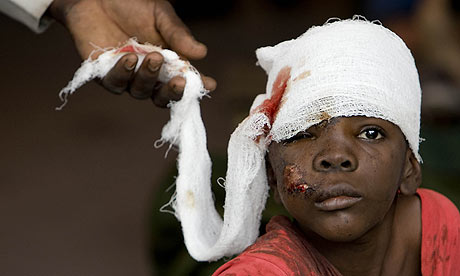
The disaster in Haiti may be one of the biggest of this century; with an estimated 100,000 dead and nearly 40,000 more victims trapped, aid cannot be put off any farther. Many countries have begun to lend a hand in the effort, with hundreds of smaller organizations pitching in to provide both food and medical supplied to those in need. With one of Haiti's main hospitals crumbled, doctors local and foreign struggle to provide much needed medical care to many families. Some suffer only minor cuts, while others have received completely severed appendages. Regardless of the injury, the Haitian people need the help of anyone who can lend a hand.


Several non-profits, such as the Red Cross, have set up text donation services, allowing cellular subscribers to donate to the relief fund and have the money deducted directly from their monthly statement. Both UNICEF and Doctors Without Borders have set up pages to accept donations as well.

Though many websites have been established to collect funds for Haiti, it is an unfortunate part of our society today that several are merely scams. The Daily Beast has done quite a good job of sorting through many of these scam sites, leaving many very legitimate charities to choose from.

Hopefully this information has cleared any donation questions up, however any readers can feel free to contact me or any of the websites listed above.

Thursday, August 13, 2009

California Wildfires: And We Thought California was 'Going Green'


As I look up on such a lovely summer night, I am greeted with an almost mystical array of red and orange clouds. At first thought, I had a bit of fear toward the nearing apocalypse in my mind, but a whiff of burning wood brought my head back out of the clouds. Another set of wildfires, nearly 100, are smoldering their way through California once again, demanding more of our precious forests as sustenance. Even though I live nowhere near these fires, I still can almost feel their presence right over the next mountain because of all of the smoke in the air. This smoke had me wondering, if I can see it a hundred miles away, what exactly is it doing to our environment? Have all our green efforts gone to the dumps?

Its a well known fact that California has very strict emissions standards. Our air is supposedly incredibly clean in comparison to many other states in the U.S. Californians truly take pride in our green state. Both Santa Cruz and San Fransisco our world renowned for their environmental awareness among other things, and the culture of those places truly reflects that. Green buses, cars, some people not even using gasoline. Many people in these areas make great efforts to have as little impact on the environment as possible. Unfortunately, these areas are now under siege by fire, which in my opinion, just blew years of green work.

These fires are huge footprints over these areas, throwing carbon right back up where people have attempted to remove it. All those green cars are now put to waste as these easily preventable fires have simply replaced the would-be emissions. All of those nasty greenhouse gases we continuously mull over explode all over California, and slowly spread globally. Its amazing fires aren't banned in California, they seem to be more negative environmentally than anything we Californians are doing to our state.


The point is something must be done about these wildfires before we worry about furthering green energy. Without these flames extinguished, anything we do would be put to was anyways. It's the responsibility of Californians and tourists here to keep our forests safe, and not spark up any new fires, for it is essential if this nation wants to 'go green'.

Also, I'd like to thank all of the brave firefighters who are risking their lives right now to attempt to put out all of the fires and end the chaos in the golden state.

Wednesday, May 27, 2009

Some things make no sense...


Chemical companies like Celanese, Dow, BASF, Eastman, oil companies like BP and Shell, and numerous other companies around the world produce butanol. They have big research budgets, and they would love to find an economical direct gasification route to butanol. These companies have looked at probably thousands of catalysts, and people have spent their careers working on this problem. The challenge is that syngas (produced from gasification) doesn’t like to form butanol. You can form a little bit directly, but CO (carbon monoxide) likes to do lots of things besides form a C4 alcohol like butanol. Scientific, I know, but Wikipedia could probably explain this process better than I could here.

Anyways, Methanol is not a problem. You can also produce ethanol, which is what Range Fuels is planning on doing (although you almost always have methanol to deal with as well). But the selectivity falls off sharply as you go to higher alcohols. By the time you get to butanol, you are lucky if 5% of the product is butanol.

So why does any of this amaze me? This is all known technology. It has been looked at for 50 years by multiple big companies spending untold millions of dollars. The economics simply don’t work, because of the very low yields. But a small company in Oregon still got someone to give them money to work on it:

"The only way Diesel Brewing could get its start was through Oregon’s business energy tax credit program — one of the most robust in the nation. The tax credit is worth 50 percent of their $1.4 million in capital costs," Stapleton said.

And then they also suggest that they will be profitable:

“Raines doesn’t expect to make a profit until the 100-ton-per-day plant is running.”

Don’t get me wrong, butanol is a fine fuel, and I have a special fondness for it (It burns quite well as a camping fuel). I would like to see it work out. But my observation is that people are seriously underestimating the difficulty of economically producing butanol from biomass.

Thursday, April 30, 2009

Fine Swine and Wine


Everyone and their mother has heard about the new variant of the swine flu epidemic, but it seems as if not one person actually knows how to deal with it. The Center for Disease Control seems as if it is merely probing at how to stop it, and the World Health Organization is just creating an uproar using its colored system of danger. And yet, it is becoming quite apparent that no one knows exactly what to do.

Based on what the media is showing them, families all over the world are concocting pitiful attempts at 'swine flu care kits', collecting things such as surgical masks and TheraFlu. Is this really necessary? A mask is not going to protect someone from contracting a rogue strain of viral proteins. What the populous should be concocting are letters to the CDC and WHO, telling them to spend less time causing a riot and more time distributing anti-virals, such as Tamiflu. As of late, WHO is only sending anti-virals to third world countries, with full knowledge that the
epidemic has spread far beyond those bounds.

There are 109 confirmed cases of swine flu in the United States alone, 257 others in 11 countries. Every country that has confirmed cases just happens not to be a third world country. I find it a tad bit strange that our global resources are heading into countries that haven't even seen evidence of any swine flu symptoms. Why should anti-virals be going to Africa if the true pandemic is in the U.S. and Europe? Both WHO and the CDC have to get their acts straight, and distribute resources to the communities who actually need protection from this epidemic. The rest of the populous, however, doesn't get off clean either. People in these malaise-ridden areas should be less concerned about how much Gatorade and cough syrup they have stocked up, and more about how to actually prevent the virus from infecting them in the first place.

World, please step up to the plate and actually do something useful for society...

Sunday, February 8, 2009

Just Tivo it...


I love my DVR. I couldn’t imagine life without it. I haven’t watched a commercial in so long that I kind of enjoy the occasional advertisement when we get side-tracked and forget to fast-forward. I love how I don’t have to stay up until 12:00 to watch House.

My sister also absolutely loves it. But, she doesn’t realize it’s the DVR she loves, she thinks it’s the normal TV. She thinks she can request any random show and that we will be able to turn it on. She doesn’t understand the sentence, “It’s not on right now.” She gets ultra impatient and demands we turn on whatever show she’s requesting. Luckily she has around 10 of her favorite, Wow Wow Wubbzy, recorded.

I think the DVR and other related technologies, like the internet and cell phones, are turning America into a country of 2 year-olds. I am not saying the technologies are bad; they’re amazing and good. What I am saying is that people cannot carry the on-demand DVR mindset over to other areas of their lives.

As we have so clearly seen in the past few years, the general public has demanded more and more under the spell of immediacy. They demand a bigger house than they can afford. They demand higher pay at a job that they don’t deserve. They demand luxuries that took their parents a lifetime of work to acquire. And when the negative consequences of the above actions reveal themselves, they demand the government provide these things. The consequence is a lack of personal responsibility and a never-ending increase in government spending and taxes.

Thinking about it, the current 25-50 year-old population did not grow up with on-demand technologies, for the most part. I can’t imagine what it’s going to be like in 25 years when generation X has grown up and the demand mindset is fully ingrained in everything they do.

Just a rant..